Biography
I teach and write about texts from the Middle Ages and theoretical and methodological questions in present-day literary studies. I am co-editor, with James Simpson, of the Norton Anthology of English Literature, Eleventh Edition, Vol. A, The Middle Ages (2024). Meanwhile, I am currently finishing a term as Book-Review Editor at the journal Exemplaria: Medieval, Early Modern, Theory.
I am also co-editor, with Professor Hussein Fancy, of The Middle Ages Book Series at the University of Pennsylvania Press. You can read the press’s announcement of new editors here. Please reach out if you’re working on a monograph that might be right for the series!
In my research, I am completing a book manuscript entitled Making Literary Persons: A Poetics of Voice in Chaucer. The monograph responds to the fact that now is an especially dynamic time to be writing about literary persons, when, in the still-unfolding aftermath of both New Criticism and poststructuralism, scholars have been rewriting the history and theory of character, narrator, and literary voice. Making Literary Persons brings the poetry of Geoffrey Chaucer to this evolving conversation. As I show, Chaucer’s work consistently portrays literary personhood pulled taut between two poles—between artifice and liveliness, metafictional contrivance and ethical charisma, and between persons’ status as fabulations, merely imagined by author or reader, and the reality of these figures’ independent presence, “in themselves” and not just “for us.” I argue Chaucer was distinctive among his contemporaries for foregrounding the hermeneutic and ethical stakes of literary persons’ unstable natures. Long a touchstone for histories of character, the Chaucerian corpus nonetheless has the ability to defamiliarize and challenge our concepts for the curious powers of literary personhood. Over six chapters, Making Literary Persons follows the arc of the poet’s career, with special attention to the ways Chaucer’s earliest works, the dream poems, set a paradigm for the later, verisimilar frame of the Canterbury Tales. Related publications include a state-of-the-field essay in Exemplaria 36.2, entitled “Writing, Voice, and Person-Making: Dispatches from Middle English Studies” and an annotated bibliography on “Literary Subjectivity, Personhood, and Character” for Oxford Bibliographies in British and Irish Literature.
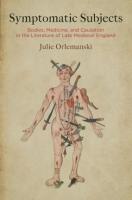
My previous monograph, Symptomatic Subjects: Bodies, Medicine, and Causation in the Literature of Late Medieval England (University of Pennsylvania Press, 2019), considers embodiment in the historical period just prior to medicine’s modernity—before Renaissance anatomy, before the centralized regulation of medical professions, before empiricism and the rationalist division of mental from physical substance. It tells the story of how bodies were interpreted and imagined between the arrival of the Black Death, in 1348, and the start of English printing in 1476. The period witnessed remarkable growth in the production of medical writings, largely for readers without university degrees. As medical paradigms mingled with other models for interpreting bodies, a growing number of readers found themselves negotiating the conflicting claims of material causation, intentional action, and divine power. Partly as a result, the later Middle Ages was, I argue, a period of etiological imagination, an age broadly fascinated with projects of explanatory invention and the tasks of narrating and arbitrating among intricate causal chains. Writers like Geoffrey Chaucer, Robert Henryson, Thomas Hoccleve, and Margery Kempe drew on the discourse of phisik—the language of humors and complexions, of leprous pustules and love sickness, of regimen and pharmacopeia—to chart new circuits of legibility between physiology and personhood. The book’s arguments unfold at the meeting of literary criticism, the history of the body, and the history of science, to chart conflicts over who had the authority to construe bodily signs and what embodiment could be made to mean.
Two other projects are percolating. I am writing a short book entitled Who Has Fiction? Modernity, Fictionality, and the Middle Ages. Histories of fiction—tracing fictionality as idea and literary pursuit across time—are often told as narratives of epistemic progress. The Middle Ages, or so-called “age of faith,” has long been a foil for modernity and its arts of fiction, especially novelistic realism. Who Has Fiction? analyzes this account and seeks to tell the story of fiction otherwise. An article laying out some of these ideas, together with a dossier of responses, is available from New Literary History here. I also have a longstanding interest in the twelfth-century abbot Bernard of Clairvaux and his masterpiece the Sermons on the Song of Songs. Bernard’s career unfolded in a period when writing and speech were being dramatically recalibrated in the organization of institutional life. He wrote his sermon collection during the same years that the upstart, reforming movement that Bernard helped lead, the Cistercian Order, was figuring out how to make its novel organizational structure function across an exploding international network of monasteries. I am working on a study that combines considerations of medieval literacy, media, monasticism, and poetic tropes of impersonation and address. Work from this project appears in my article “Literary Persons and Medieval Fiction in Bernard of Clairvaux’s Sermons on the Song of Songs.”
Select Publications
- Symptomatic Subjects: Bodies, Medicine, and Causation in the Literature of Late Medieval England (Univ. of Pennsylvania Press, 2019)
- “Between Voice and Name, or, Chaucer Theorizes Literary Person-Making.” ELH 92.3 (2025): 933-963.
- “The Apple of Experience: Erich Auerbach on Adam and Eve,” in Close Reading for the Twenty-First Century (2025), ed. Dan Sinykin and Johanna Winant
- “Phoenician Ontology and the Art of Species, or Jean de Meun Rewrites the Bestiary,” in Medieval Bestiaries: New Approaches (2025), ed. Debra Strickland
- “What Is ‘Postmedieval’?: Embedded Reflections,” in boundary 2 50:3 (2023)
- “Fiction and Belief: Approaching Medieval Latin Christendom,” in The Routledge Handbook on Fiction and Belief (2023), ed. Alison James, Françoise Lavocat, and Akihiro Kubo
- “Langland’s Poetics of Animation: Body, Soul, Personification,” in the Yearbook of Langland Studies 33 (2019)
- “Medieval Literary Theory,” in the Literary Encyclopedia, vol. 1.2, English Writing and Culture: Medieval and Early Modern England, 1066-1485
- “Philology and the Turn Away from the Linguistic Turn,” in Florilegium 32 (2017 for 2015)
- “Literary Genre, Medieval Studies, and the Prosthesis of Disability,” in Textual Practice 30.7 (2016)
- “Scales of Reading,” in Exemplaria 26.2-3 (2014), special issue on “Surface, Symptom, and the State of Critique”
- “Genre,” in A Handbook of Middle English Studies (2013), ed. Marion Turner, Wiley-Blackwell Critical Theory Handbooks