As a scholar of poetry and culture working across media and historical periods — antiquity, modernity, and the in-between — I try to understand why we so often confront the world by interrupting our relation to it.
Biography
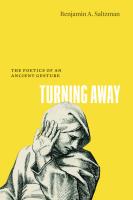
My most recent book, Turning Away: The Poetics of an Ancient Gesture (University of Chicago Press), was supported by a fellowship from the National Endowment for the Humanities and received a Roger W. Weiss and Howard Mayer Brown subvention from the Newberry Library. You can listen interviews about the book here or read a selection of recent reviews.
In this book, I ask what it means to turn from the afflictions of others, what it means to lower our heads in grief or cover our faces in shame. By looking to the past, I recover such gestures of aversion as an essential aspect of being human and engaging with the world. These are often inscrutable gestures at the limits of expression, gestures that pose life's most difficult confrontations.
Into the horizon of contemporary discourse, I set out from five premodern scenes in which a figure looks away or covers their face: Agamemnon in Timanthes’s Sacrifice of Iphigenia, Leontius in Plato’s Republic, Alypius in Augustine’s Confessions, the onlookers to the Crucifixion in medieval and early modern art, and illustrations of Adam and Eve in their postlapsarian state. These scenes refract across a sea of art and poetry and philosophy. They ripple through the art of Francisco Goya, Marc Chagall, Salvador Dalí, and Rotimi Fani-Kayode, across the poetry of John Donne, William Blake, and Langston Hughes, alongside the thinking of Hannah Arendt, Walter Benjamin, Hans Blumenberg, Ralph Ellison, and Primo Levi. Along the way, the affective multivalences of these gestures invite us to reflect on our own relation to the suffering of others and our reflexive discomfort when we happen to turn away.
Past projects
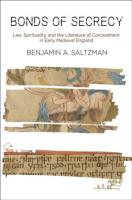
My scholarship has been shaped by my training in the study of Old English Poetry. My first book, Bonds of Secrecy: Law, Spirituality, and the Literature of Concealment in Early Medieval England (University of Pennsylvania Press, 2019), investigates the tensions between the medieval Christian belief in divine omniscience and the social experience of secrecy. I argue that as these tensions manifested in the legal culture and monastic life of early medieval England, they profoundly shaped the practices of literary interpretation during the period. Supported by fellowships from the ACLS/Mellon Foundation and the National Endowment for the Humanities, Bonds of Secrecy is complemented by articles in journals such as PMLA and Speculum, among others. I also wrote for the Washington Post and was interviewed by the New York Times about how the early medieval belief in God’s omniscience can help us understand the societal consequences of today’s global data economy.
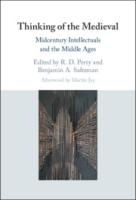
My work has become increasingly transhistorical, motivated by the question of how we have inherited and responded to the intellectual traditions of the past. Thinking of the Medieval: Midcentury Intellectuals and the Middle Ages (Cambridge Univ. Press), which I co-edited with R. D. Perry and which includes an afterword by Martin Jay, is a collection of essays that trace how major intellectual figures of the twentieth century—among them Hannah Arendt, Erich Auerbach, W. E. B. Du Bois, Frantz Fanon, and Simone Weil—engaged with the medieval past to arrive at some of their most influential ideas.
New projects
I am now working on a new book—Waveforms: Of Poetry and the Sea, or alternately, Like as the Waves. This book follows the intuitive analogy between poetry and the sea, between their rhythms, histories, textures, sounds, between the joys of playing in (or the terrors of being plunged into) their movements. I’m curious about what being moved by waves teaches us about being moved by a poem. What does poetry take from the sea? What language does the sea give to poets, and poets to the sea? What, I wonder, does it mean to compare life to a wave, or a wave to a poem?
Across more than twenty essayistic chapters, I read a wide range of poems and poets: The Seafarer, Homer’s Odyssey, Alice Oswald’s Nobody, John Ashbery’s A Wave, H.D.’s “Oread,” Marianne Moore’s “The Fish,” Cecilia Vicuña, M. NourbeSe Philip, Mallarmé, Dickinson, Darwish, Pound, Stevens, Neruda, Shakespeare (“Like as the Waves . . .”), and many others. In the confluence of these poems, I am attempting an experimental, undulating book about the nature of poetic analogy.
Other responsibilities
I currently serve as Editor of Modern Philology and Deputy Dean in the Division of the Arts and Humanities. I have previously served as the Director of the Program in Medieval Studies and the Director of Undergraduate Studies in the Department of English.
Select Publications
- “Witnessing Saint Margaret, or the Frenetic Historicity of the Inconceivable,” Yearbook of English Studies, special issue on “Literature to 1200,” ed. Lees and Davies (2022). Download Article
- “Hermeneutics and the Medieval Horizon: Zumthor, Jauss, Barthes, and Gadamer” in Thinking of the Middle Ages: Midcentury Intellectuals and the Medieval, ed. Perry and Saltzman (Cambridge, 2022). Download Article
- “Community, Joy, and the Intimacy of Narrative in Beowulf” in Dating Beowulf: Studies in Intimacy, ed. Remein and Weaver (Manchester, 2020). Download Article
- “Vt hkskdkxt: Early Medieval Cryptography, Textual Errors, and Scribal Agency.” Speculum 93, no. 4 (forthcoming, 2018): Download Article
- “Secrecy and the Hermeneutic Potential in Beowulf.” PMLA 133, no. 1 (2018): 36-55: Download
- “The Friar, the Summoner, and their Techniques of Erasure.” The Chaucer Review 52, no. 4 (2017): 363-95: Download
- “Towards the Middle Ages to Come: The Temporalities of Walking with W. Morris, H. Adams, and Especially H. D. Thoreau.” postmedieval 5, no. 2 (2014) 235-52: Download
- “The Mind, Perception and the Reflexivity of Forgetting in Alfred’s Pastoral Care.” Anglo-Saxon England 42 (2013): 147-82. Download
- “William Morris’s ‘Golden Wings’ as a Poetic Response to the ‘Delicate Sentiment’ of Tennyson’s ‘Mariana.’” Victorian Poetry 49, no. 3 (2011): 285-99. Download
- “Writing Friendship, Mourning the Friend in Late Anglo-Saxon Rules of Confraternity.” Journal of Medieval and Early Modern Studies 41, no. 2 (2011): 251-91. Download
Teaching
- History of the English Language
- The Middle Ages in the Twentieth Century
- Witnessing Medieval Evil: Art, Literature, and the Politics of Observation
- Old English Language and Literature
- Beowulf
- Old English Riddles